

Quick answer: junk removal pricing comes down to volume first — how much space your stuff takes up in the truck. For general household trash, that works out to roughly $40–$60 per cubic yard as an industry-standard rate. From there, access, weight, and material type all push the number up or down. (We just told you the formula for free — if it were this simple to game, we'd be out of a job. Keep reading, the factors below are where it actually gets decided.)
If you've ever gotten wildly different quotes from two junk removal companies for what looked like the same pile of stuff, you're not imagining it — pricing in this industry is genuinely confusing, and a lot of companies don't explain it well. Here on the South Shore, MA, we quote every job the same way: in person or from photos, based on what's actually there, not a guess over the phone. This guide walks through exactly how that number gets calculated, so you know what you're paying for before we ever show up.
Skip The Math — Get A Real Quote
Fill this out or call 781-820-2113 and we'll get back to you with an upfront price, usually same-day.
How Junk Removal Pricing Works: Volume First
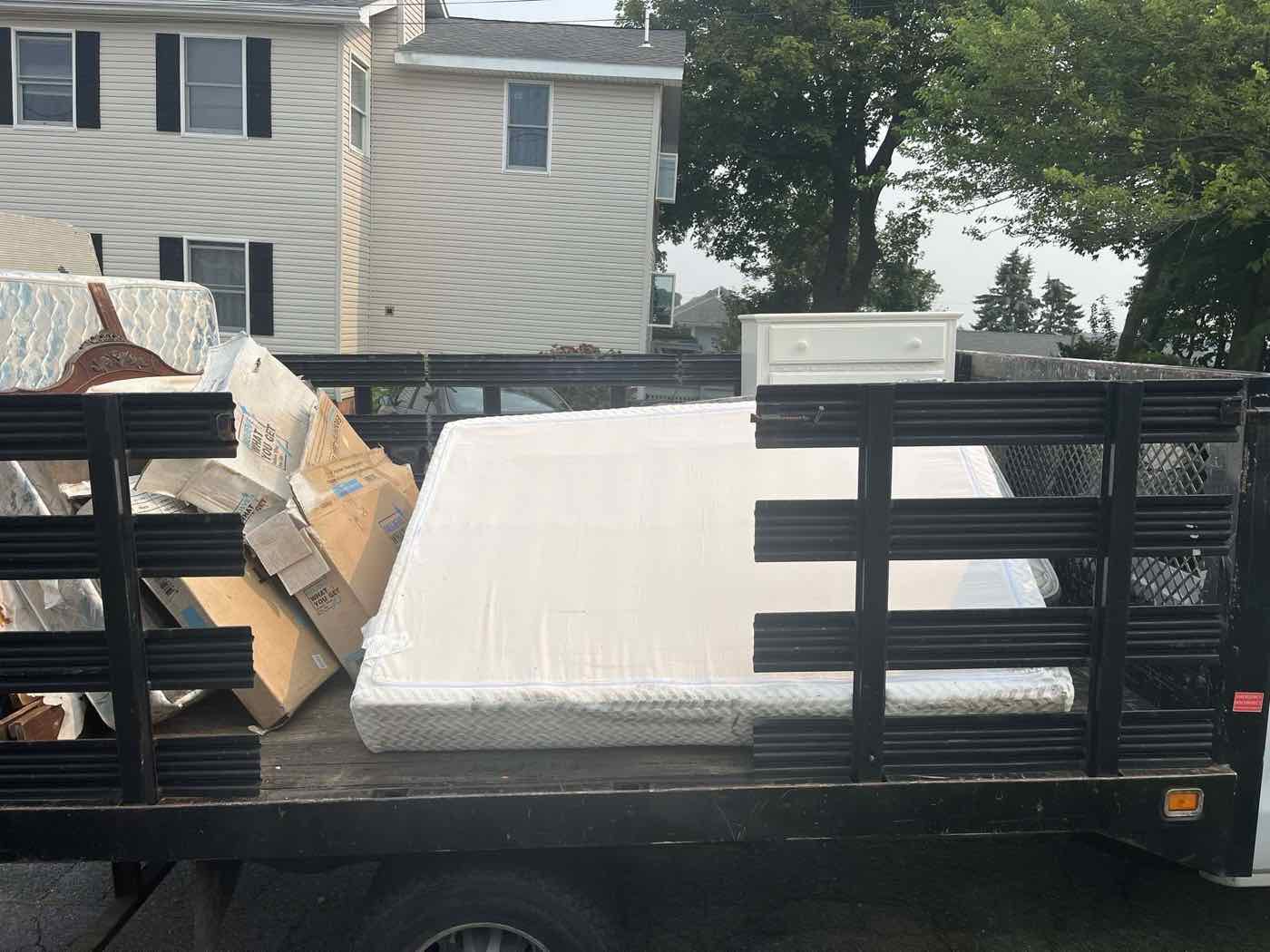
Most junk removal companies, us included, price primarily by volume — how much of the truck your junk fills up, usually measured in cubic yards or as a fraction of a truckload (an eighth, a quarter, a half, a full load). It's the same logic as a dumpster rental: you're paying for space, not just for stuff to disappear.
For general household trash — old furniture, boxes, clutter, the usual — the industry-standard rate runs about $40 to $60 per cubic yard. A single armchair might be a fraction of a cubic yard. A cleared-out spare room could easily be 8–10 cubic yards. That's why we always want to see or hear about the actual volume before quoting a number — "a truckload of stuff" means very different things to different people.
What Else Changes The Price
Volume gets you most of the way to a number, but a few other factors move it from there:
- Access: Curbside or driveway pickups are the fastest and cheapest. Basements, upstairs bedrooms, or multiple flights of stairs take more labor time, which shows up in the quote — this is the single most common reason two "similar" jobs price differently.
- Weight: Volume drives most quotes, but dense material (concrete, dirt, tile, packed file boxes) weighs far more than its size suggests and can push a job into a higher bracket even without filling much space.
- Material type: Some items just cost more to dispose of properly — more on that below.
- Disassembly: Items that need to be broken down (sheds, swing sets, large furniture that won't fit through a doorway whole) add time on-site.
None of this is exotic — it's the same logic behind why a mover charges more for a fourth-floor walkup than a ground-floor apartment. More labor, more time, higher price.
You tell us what to toss, and we do all the heavy lifting — including the flights of stairs. We'd rather factor access into an honest upfront quote than surprise you with an add-on fee after the truck is already loaded.
Get a Free, No-Surprises QuoteWhy Some Materials Cost More Than Others
This is the part flat "per cubic yard" math doesn't fully capture: certain materials come with disposal or recycling requirements that regular household trash doesn't. A few examples:
- Appliances with refrigerant (fridges, freezers, AC units) legally require certified refrigerant recovery before disposal under EPA Section 608 rules — that's a real compliance step, not a made-up fee.
- Mattresses and electronics are on Massachusetts' banned disposal list, meaning they're required by law to be recycled rather than landfilled — recycling costs more than dumping, so that gets reflected in the price.
- Tires, paint, and other chemicals generally need separate handling from general junk, similar to what we cover in our basement cleanout guide and garage cleanout guide.
None of this is us padding the bill — it's the actual cost of doing disposal the right way instead of the cheap way. Here's an opinion we'll state plainly: a quote that doesn't account for what's actually in the pile isn't a real quote, it's a guess that gets "corrected" once the crew shows up. We'd rather ask a couple of questions upfront and give you a number that holds.
What This Looks Like In Real Numbers
To put the volume math in context, here's roughly what different job sizes tend to run, based on typical industry ranges for general household junk:
- Single item (one couch, one mattress, one appliance): usually a minimum-charge job, often under $150.
- Quarter load (a few pieces of furniture, several boxes): roughly $150–$300.
- Half load (a cleared closet, small room, or garage corner): roughly $300–$450.
- Full load (a full room, garage, or small cleanout): roughly $500–$800+, depending on access and material type.
These are market-typical ranges, not a guaranteed price — the only way to get a real number is a quick look at what you actually have, whether that's a call, a text with photos, or an in-person estimate.
Real example of how fast we move once a price is agreed on: we picked up a brand-new 15-yard dumpster from the factory on a Thursday night and had it rented out by Friday morning. Junk pickups get the same urgency — quote today, truck there tomorrow in most cases.
How We Quote Every Job
Here's the stance we don't hedge on: the deal should be simple. We show up (or ask for photos), give you a free quote, and if you like the price, we haul it away right then and there. No callback, no second visit just to confirm what we already saw, no "final price" that's mysteriously higher than the estimate.
- Tell us what you've got: Call, text, or send photos — the more specific, the more accurate the quote.
- Get a real number: We quote based on volume, access, and material type, not a generic guess.
- Same-visit haul-away: If the price works for you, our crew loads and hauls it that same visit in most cases.
- No surprise fees: Anything that could change the price (stairs, hazardous items, disassembly) gets flagged before we start, not after.
How To Get The Best Price
- Group items together in one accessible spot rather than spread across the house — it cuts down labor time, which is part of the quote.
- Flag hazardous items separately (paint, oil, chemicals, propane) ahead of time so they don't complicate the rest of the load.
- Be specific in your initial call or text — "a truckload of stuff" gets a rougher estimate than "a couch, a dresser, and about 15 boxes."
- Combine trips when it makes sense — clearing a garage and a basement in the same visit is usually cheaper than booking two separate jobs.
Pricing For Specific Jobs
General pricing logic is useful, but if you're planning a specific job, our dedicated guides go deeper on cost ranges for that exact situation:
- Basement cleanout pricing — what a packed basement typically runs
- Garage cleanout pricing — including why you usually don't need a dumpster rental for a garage-only job
- Full service list — for estate cleanouts, demolition, and commercial jobs
Areas We Serve
We quote and run junk removal jobs throughout the South Shore, including:
Frequently Asked Questions
Is junk removal priced by volume or by weight?
Mainly by volume — how much space your items take up in the truck. Weight comes into play for dense materials like concrete, dirt, or construction debris, which can push the price higher even if they don't take up much room.
How much does junk removal cost per cubic yard?
For general household trash, the industry-standard range is about $40-$60 per cubic yard. That range shifts based on item type, access, and local disposal fees.
Do you charge extra for stairs, basements, or hard-to-reach areas?
Access affects labor time, which affects price. Curbside pickups are the fastest and cheapest; hauling items up from a basement or down multiple flights of stairs takes longer and is reflected in the quote.
Why do some items cost more to remove than others?
Certain materials carry higher disposal or recycling fees — appliances with refrigerants, mattresses, electronics, and hazardous items all require special handling under state and federal rules, which adds cost beyond a simple volume calculation.
Is there a minimum charge for junk removal?
Yes, most jobs — including ours — have a minimum charge to cover the trip and labor, even for a single item. We'll always tell you the minimum upfront before we schedule anything.
Do you charge a flat rate, or is every job quoted individually?
Every job gets its own quote based on volume, access, and item type — we don't do generic flat rates because no two jobs actually cost the same to run.
What happens to the items after pickup?
We donate and recycle whenever possible and only send items to disposal as a last resort, keeping as much out of the landfill as we can.